◉
Listen
Capture voice through a USB microphone and manage interaction on an ESP32-S3.
 View prototype
EdgeTalk explores compact, voice-first AI interfaces for embedded devices—connecting microphones, displays, speakers and device actions to a cloud reasoning layer.
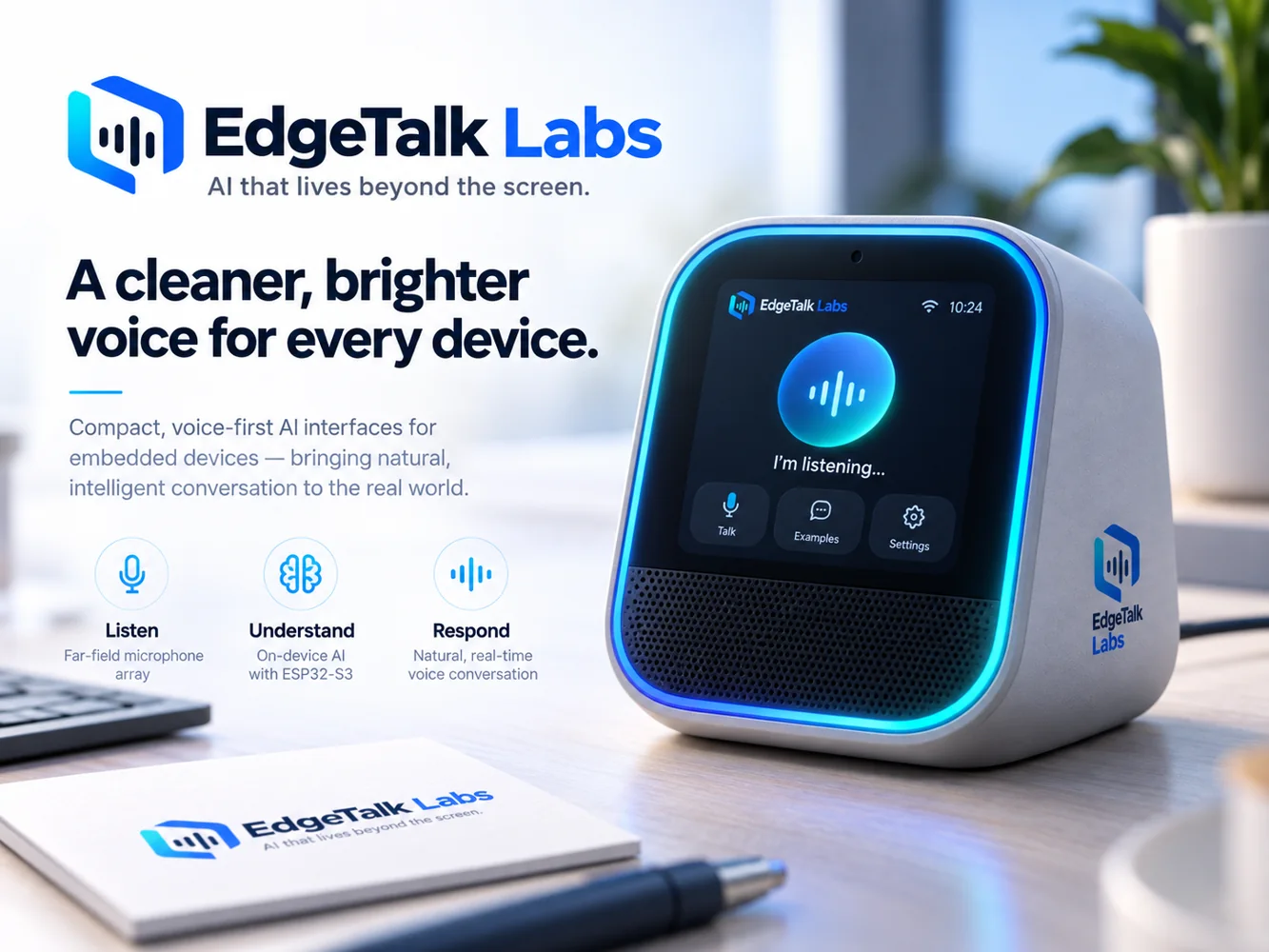
The project focuses on a simple idea: let a physical device listen, reason in the cloud, and respond through the hardware around it.
Capture voice through a USB microphone and manage interaction on an ESP32-S3.
Send structured requests over HTTPS to a frontier model API. Claude is the initial target reasoning layer.
Return spoken output, on-device visual feedback, or structured actions to connected hardware.
Current work is centered on an ESP32-S3 development platform with audio I/O, a compact TFT display, networking and device-state control.
Audio, display, networking and device-side control are the core prototype layer.
Claude API integration is planned as the next development milestone.
Enclosure, onboarding, reliability and repeatable deployment are future milestones.
A deliberately modular pipeline keeps the embedded layer lightweight while allowing the reasoning layer to evolve.
Integration note: Claude integration is planned. Speech recognition and speech synthesis are separate services in the proposed architecture.
Natural-language control and feedback for small connected devices and appliances.
A hands-on bridge between embedded systems, AI APIs and human-device interaction.
A reusable reference architecture for voice-first prototypes with displays, audio and device actions.
The project is evaluating Claude as the first cloud reasoning layer for contextual conversation and structured device responses. Program support and API credits would be used to move from embedded I/O experiments toward a repeatable end-to-end prototype.
EdgeTalk Labs is an independent prototype project in Taiwan, exploring voice interfaces for embedded devices.
The project is at the personal-prototype stage, with a goal of developing a repeatable reference platform for makers and small device teams. EdgeTalk Labs is a working project name and is not currently an incorporated company.
The next milestone is a voice-to-response demonstration on hardware, followed by measured latency, reliability, and cost evaluation.